Why I Swear by Tai Chi for Everyday Calm and Strength
You don’t need intense workouts to feel stronger and more centered—sometimes, slow is the fastest way forward. I used to think Tai Chi was just for seniors in the park, but after weeks of testing it myself, I noticed real shifts: less tension, better balance, and a quieter mind. It’s not magic—it’s movement with purpose. This is my honest take on how Tai Chi changed my health mindset, and why it might be the missing piece in your wellness routine too.
The Moment I Gave Tai Chi a Real Shot
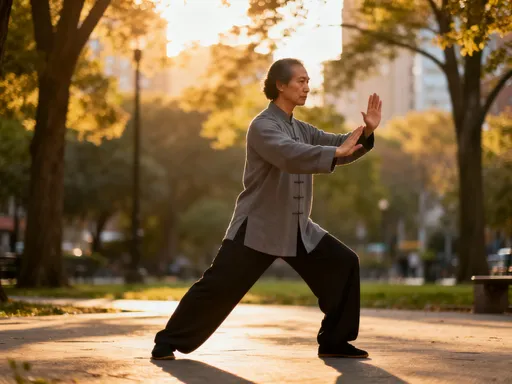
Like many people, I once walked past groups practicing Tai Chi in the park and assumed it was something only retirees did to pass the time. To me, real exercise meant breaking a sweat, feeling the burn, and tracking progress through speed or strength gains. Tai Chi, with its flowing, almost dreamlike motions, didn’t seem to fit that definition. I dismissed it as gentle stretching dressed up with philosophy. That changed when a minor back strain from lifting groceries left me unable to do the workouts I once relied on. My doctor didn’t recommend surgery or medication—just rest and low-impact movement that wouldn’t aggravate my spine. That’s when I finally decided to try Tai Chi, not because I believed in it, but because I had few other options.
My first session at a local community center was humbling. I stood in the back, trying to mimic the instructor’s slow, deliberate gestures, but my body felt stiff and uncoordinated. The movements—shifting weight from one foot to the other, raising arms as if pushing through water—felt strange, even silly at first. I wasn’t sweating, my heart rate didn’t spike, and I kept wondering if anything was actually happening. But I committed to practicing three times a week for at least ten minutes, treating it like a health experiment. Within two weeks, I began to notice subtle changes. My lower back pain eased. My posture improved without conscious effort. Most surprisingly, I started waking up feeling more rested, even on days when I hadn’t slept more than usual. The turning point wasn’t dramatic—it was cumulative. The quiet consistency of Tai Chi began to reshape not just my body, but how I thought about movement and well-being.
What Tai Chi Actually Is (And What It Isn’t)
Tai Chi, also known as Tai Chi Chuan, is a mind-body practice that combines slow, controlled movements with deep breathing and mental focus. It originated in China centuries ago, rooted in martial arts and traditional Chinese medicine, but today it’s widely practiced as a form of low-impact exercise that supports both physical and mental health. Each form—a sequence of movements—flows into the next, creating a kind of moving meditation. Unlike high-intensity interval training or weightlifting, Tai Chi doesn’t rely on speed or resistance. Instead, it emphasizes coordination, balance, and awareness of how the body moves through space.
One of the most common misconceptions is that Tai Chi is merely performance art or something mystical with no real health benefit. Some people assume it’s about energy channels or esoteric philosophies. While it does have cultural and historical roots in Daoist thought, modern practice—especially in wellness and rehabilitation settings—is grounded in functional movement science. Research from institutions like Harvard Medical School and the National Institutes of Health has shown that Tai Chi improves balance, reduces fall risk in older adults, and helps manage chronic pain. It’s not about belief; it’s about biomechanics and nervous system regulation. The slow pace isn’t a sign of ineffectiveness—it’s a design feature. By moving deliberately, practitioners develop greater body awareness, which translates into better control in everyday activities.
Another myth is that you need years of training to benefit. While mastery takes time, even short-term practice yields measurable results. Studies have found that people who practice Tai Chi for just 12 weeks report improvements in flexibility, mood, and sleep quality. You don’t need special equipment, a large space, or prior experience. What you do need is consistency and a willingness to slow down. Tai Chi isn’t about looking graceful or achieving perfect form. It’s about tuning in—feeling the shift of weight, noticing your breath, and reconnecting with your body in a way that fast-paced life rarely allows.
Why Modern Bodies Need This Ancient Practice
Today’s lifestyle is built on constant motion—rushing between tasks, staring at screens, and managing endless streams of information. Our bodies weren’t designed for this kind of sustained mental and physical tension. Many of us spend hours seated, leading to poor posture, tight hips, and weakened core muscles. At the same time, our nervous systems are overstimulated, stuck in a low-grade state of fight-or-flight that elevates stress hormones like cortisol. This chronic activation wears down both mental and physical resilience, contributing to fatigue, anxiety, and even long-term health issues like high blood pressure and weakened immunity.
Tai Chi directly counteracts these modern challenges. Its slow, rhythmic movements activate the parasympathetic nervous system—the part responsible for rest and recovery. This is sometimes described as a “system reset” for the body. With each controlled motion and deep breath, the nervous system receives signals that it’s safe to relax. Over time, this helps lower baseline stress levels. A study published in the Journal of Clinical Psychology found that regular Tai Chi practice reduced symptoms of anxiety and depression in adults, with effects comparable to cognitive behavioral therapy in some cases. Unlike medication or talk therapy, Tai Chi offers a physical pathway to mental calm.
Another critical benefit is improved proprioception—your body’s ability to sense where it is in space. This declines with age and inactivity, increasing the risk of falls and injuries. Tai Chi strengthens this internal GPS by requiring precise weight shifts and controlled transitions. For example, moving from one leg to the other while maintaining balance trains the muscles, joints, and brain to communicate more effectively. It’s like upgrading your body’s software. Additionally, the focus required during practice—on breath, alignment, and flow—acts as a form of attention training. In a world of constant distractions, this ability to sustain focus without strain is a rare and valuable skill. Tai Chi doesn’t just strengthen muscles; it strengthens the mind-body connection, which is often neglected in conventional fitness routines.
The Real Health Shifts I’ve Felt—No Hype
After six months of consistent practice—starting with ten minutes a day and gradually increasing to twenty—I began to notice changes that weren’t just subjective. They were tangible, measurable, and integrated into my daily life. One of the first improvements was in my sleep. I’ve always been someone who wakes easily, often lying awake with thoughts circling. But within a few weeks of evening Tai Chi sessions, I found it easier to fall asleep and stay asleep. I wasn’t doing anything else differently—no new supplements, no changes in caffeine intake. The only variable was the practice itself. Research supports this: a 2020 meta-analysis in Sleep Medicine Reviews concluded that mind-body exercises like Tai Chi significantly improve sleep quality, especially in middle-aged and older adults.
Another clear shift was in my physical tension. I work from home, and like many, I spend hours at a desk. Shoulders creeping up toward my ears, a stiff neck, lower back discomfort—these were my normal. After a few weeks of Tai Chi, I noticed I wasn’t reaching for the heating pad as often. My shoulder tension decreased, and my posture became more upright without conscious effort. I attribute this to the way Tai Chi emphasizes spinal alignment and shoulder relaxation. Movements like “Raise Hands to Heaven” and “Grasp the Sparrow’s Tail” require opening the chest and rolling the shoulders back, counteracting the forward hunch of desk work. These aren’t isolated stretches; they’re integrated into a full-body flow that trains the body to move more efficiently.
Balance was another area where I saw real progress. At my annual check-up, my doctor asked me to stand on one leg with my eyes closed—a standard test for fall risk. A year earlier, I could barely hold it for five seconds. After Tai Chi, I lasted over twenty. This wasn’t just a number; it reflected greater confidence in daily life. I felt steadier walking on uneven sidewalks, getting in and out of the car, and even reaching for items on high shelves. These small victories added up. I also noticed improved mental clarity during work. Tasks that used to feel overwhelming became more manageable. I wasn’t multitasking more—I was focusing better. The practice of staying present during Tai Chi seemed to carry over into other areas, reducing mental clutter and improving decision-making. These weren’t overnight transformations. They built gradually, like layers of trust between my body and mind.
How to Start Without Feeling Silly or Overwhelmed
If you’ve never tried Tai Chi, the idea of slow, flowing movements might feel awkward or even intimidating. That’s completely normal. The key is to start small and remove the pressure to be perfect. You don’t need a park, a robe, or an hour of free time. Begin with just five to ten minutes a day, ideally in a quiet space where you won’t be interrupted. Wear comfortable clothing and flat, supportive shoes—or go barefoot if the surface allows. The goal isn’t performance; it’s presence. Focus on how your body feels, not how it looks.
There are many free, high-quality resources available online. Reputable organizations like the American Tai Chi and Qigong Association and the National Center for Complementary and Integrative Health offer beginner-friendly videos and guides. Look for instructors who emphasize alignment, breath, and accessibility rather than martial applications. A good starting sequence is “Wave Hands Like Clouds,” which involves shifting weight side to side while gently moving the arms in a circular motion. It’s simple, meditative, and teaches core principles of weight transfer and coordination. Another foundational form is “Parting the Horse’s Mane,” which introduces forward and backward weight shifts while maintaining a stable posture. These forms are often taught in beginner classes and are easy to practice at home.
One of the most helpful mindset shifts is to let go of the idea of “doing it right.” Tai Chi isn’t about perfection—it’s about awareness. Some days your balance might be off, or your mind might wander. That’s okay. The practice is in returning your attention, not in achieving flawless execution. Think of it like learning to ride a bike: wobbling is part of the process. Over time, the movements become more natural, and the benefits accumulate. If you’re concerned about space, remember that Tai Chi can be adapted. You don’t need a large yard—just enough room to extend your arms without hitting furniture. Even practicing near a wall for support is acceptable, especially if balance is a concern. The most important thing is to begin, without judgment or expectation.
Fitting Tai Chi into Real Life—Not Just Parks at Dawn
One of the biggest misconceptions about Tai Chi is that it only belongs in serene outdoor settings at sunrise. While practicing in nature can enhance the experience, it’s not a requirement. The beauty of Tai Chi is its flexibility. It can be woven into the fabric of daily life, no matter how busy or unpredictable your schedule. I’ve practiced in my living room before work, during lunch breaks at the office, and even in hotel rooms while traveling. The only tools I need are my body and a few minutes of quiet.
For many women in their 30s to 50s, time is a precious commodity. Between work, family, and household responsibilities, adding another “should” to the list can feel overwhelming. But Tai Chi doesn’t have to be another task—it can be a reset. Try doing a short sequence first thing in the morning to set a calm tone for the day. Even five minutes of “Opening the Cocoon” or “Lifting the Sky” can help you transition from sleep to wakefulness with greater ease. If mornings are chaotic, use Tai Chi as a midday pause. Step away from your desk, close the door, and move through a few gentle forms. This isn’t indulgence—it’s maintenance. Just as you wouldn’t skip brushing your teeth, consider Tai Chi a non-negotiable part of your self-care routine.
Evening practice can serve as a transition from work mode to home mode. Instead of collapsing onto the couch with a screen, spend ten minutes moving slowly and breathing deeply. This helps signal to your body that it’s time to wind down. If you have children or live with others, you don’t need to isolate yourself. Some families practice together, turning it into a shared wellness ritual. The point is to normalize Tai Chi as a practical, everyday tool—not a performance or a chore. You don’t have to wear special clothes or follow a strict schedule. You just have to show up, even if only for a few minutes. Over time, these small moments add up to lasting change.
Shifting Your Health Mindset: From Pushing Hard to Moving Wisely
One of the most profound effects of Tai Chi has been on my understanding of what it means to be healthy. For years, I equated fitness with intensity—long runs, heavy weights, high-rep workouts. I believed that if I wasn’t exhausted afterward, I hadn’t done enough. Tai Chi challenged that belief. It taught me that strength isn’t just about power or endurance; it’s also about stability, control, and resilience. True fitness includes the ability to recover, to stay calm under pressure, and to move with ease through daily life. Tai Chi builds that kind of strength—the kind that doesn’t show up on a scale or in a race time, but in how you feel from day to day.
This shift in mindset has made my approach to wellness more sustainable. Instead of chasing quick fixes or extreme results, I focus on consistency and awareness. I’ve learned to listen to my body rather than push through pain. I value rest as much as activity. This doesn’t mean I’ve given up on other forms of exercise—I still walk, stretch, and do light strength training. But Tai Chi has become the foundation, the practice that keeps everything else in balance. It’s like the anchor in a stormy sea, providing stability when life feels chaotic.
For women navigating the demands of midlife—whether it’s parenting, career pressures, or caring for aging parents—this kind of balanced approach is essential. Health isn’t just about avoiding illness; it’s about thriving. Tai Chi supports that by fostering a sense of inner calm, physical confidence, and mental clarity. It’s not a cure-all, but it’s a powerful tool. And perhaps most importantly, it’s accessible. You don’t need a gym membership, special equipment, or a lot of time. You just need the willingness to slow down and move with intention. In a world that glorifies speed and productivity, choosing slowness can feel radical. But sometimes, the most revolutionary act is to pause, breathe, and remember what it feels like to be present in your body.
In the end, my journey with Tai Chi wasn’t about becoming an expert or mastering complex forms. It was about rediscovering a simpler, more mindful way of moving and being. It started as a solution to back pain and turned into a lifelong practice. The benefits—better sleep, less tension, improved balance, and a quieter mind—are not exaggerated. They are real, measurable, and available to anyone willing to give slow motion a real chance. If you’ve ever felt overwhelmed by the pace of modern life, or if your body carries the weight of daily stress, consider this an invitation. You don’t need to be flexible, athletic, or young. You just need to begin. Let Tai Chi remind you that wellness isn’t always loud, fast, or dramatic. Sometimes, it’s quiet, steady, and deeply human.